
Nobody owns it
HubSpot was set up two or three years ago, probably by an agency. The person who understood it has left. It works well enough that nobody has time to fix it.
Fractional revenue operations
The usual story
HubSpot was set up two or three years ago, probably by an agency. The person who understood it has left. It works well enough that nobody has time to fix it.
Nobody is certain which automations still run, which ones send email, or what breaks if you turn one off. So none of them get touched.
A deal closes, and a person opens a second system and enters it all again. That handoff is where small companies quietly lose hours every week.
Fig. 1 · the seam
Fig. 1 · the seam
It's hard to tell from the outside how deep a mess goes. Four hours of cleanup, or forty. You can't price the fix until you know which.
So I start small. A fixed-scope review of your systems, then a written document: what's broken, what each thing costs you, and how much work it is to fix. One week, from the day I get access to the findings in your hands.
What I look at
That last one is the part most people skip. It's usually where the money is.
You keep the document either way. Hand it to someone internal if you'd rather. That's a fine outcome.
Fig. 2 · one week, fixed scope
Fig. 3 · three rungs, one price
| 01$850 | The audit. A fixed-scope review of your systems, then a findings walkthrough. One week from the day I get access. Everyone starts here. |
| 02Fixed price | Stabilization. Fixed price and fixed scope, drawn from the audit's fix list. Priced against what I actually find, not a bracket guessed at beforehand. |
| 03Monthly | Ongoing. I own it. Cancel whenever it stops being useful. |
You're never obliged to move to the next step. The audit is the only thing you can buy today, and it's the only price on this page for that reason.
What this site runs on
This site, the form you're about to fill in, and the booking page it sends you to are all HubSpot, because that's what I run myself. The pattern is the same wherever you are: Salesforce or Pipedrive on the front end, an ERP like Odoo, NetSuite or Epicor on the back end. I built all of this, and it's the same kind of work I'd do on your stack, whatever it is.
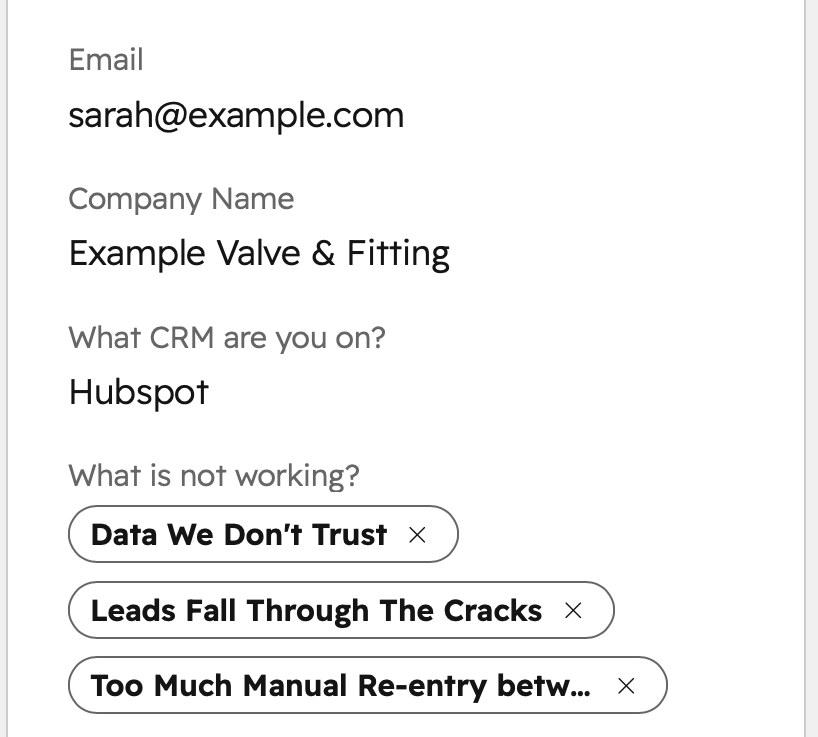
Lead capture → CRM. A submission from the form on this page, landing as a contact with the qualifying answers already on the record. No re-keying, no “I think it emails Susan.”

Email authentication. SPF, DKIM and DMARC on datumoperations.com, verified by an independent tool. This is item four of the audit, and most companies fail it without knowing.
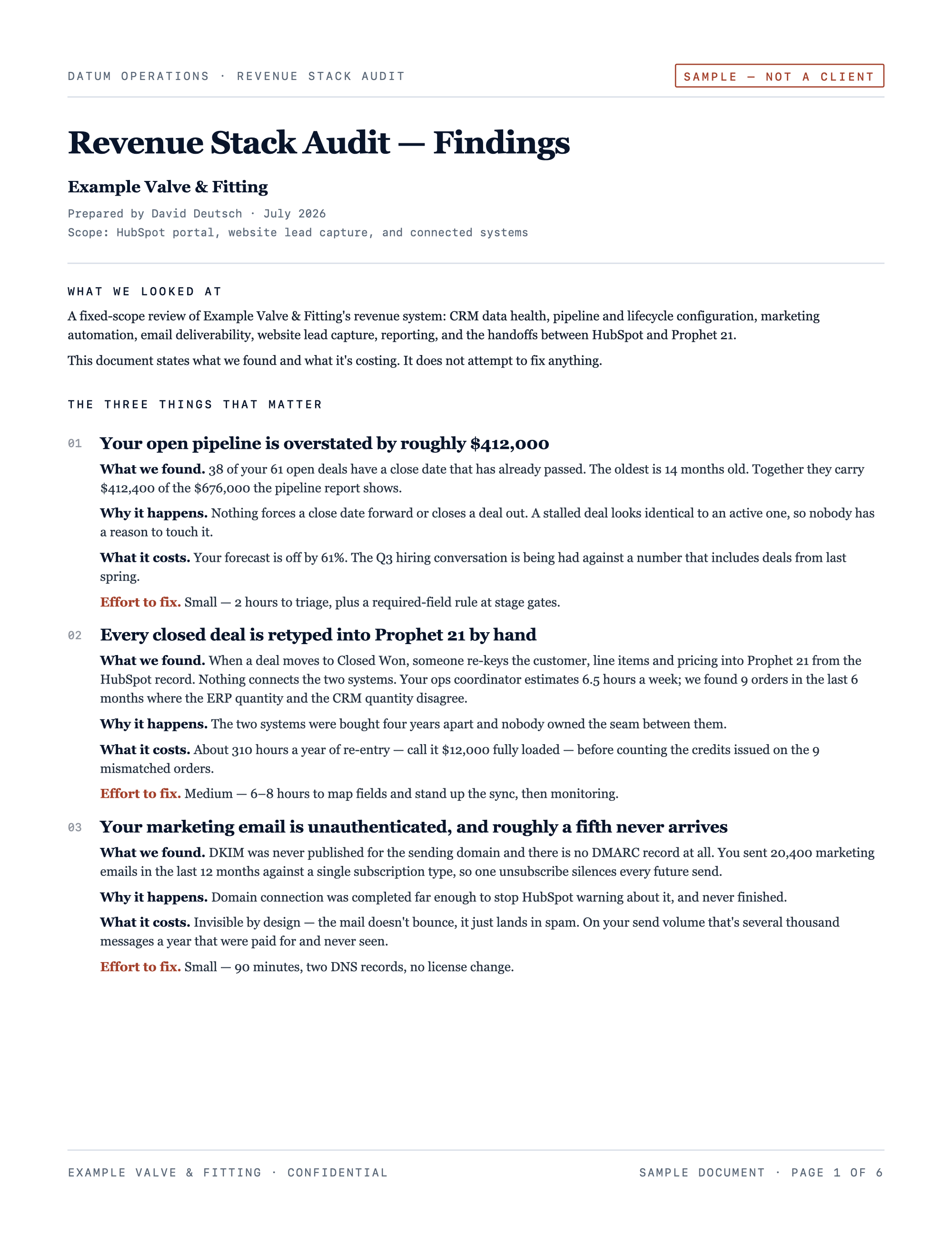
The deliverable. Findings ranked by what they cost you, with the effort to fix each. Sample content, but the structure is what's real.
If your setup did all three of those things, you wouldn’t need me.

An open loop
| 01 | Sales promises a date | |
| 02 | Re-keyed by hand | MANUAL |
| 03 | Finance raises the invoice | |
| 04 | Nothing flows back | BROKEN |
Closing that loop is the job.

I'm David Deutsch. Four years inside Odoo Inc. on the ERP side, and about a decade selling B2B.
Plenty of people know HubSpot. Far fewer know what happens after the deal closes. How an order actually gets created, where the invoice comes from, why finance doesn't trust the sales number. Most CRM problems turn out to be back-office problems wearing a CRM costume.
I watched that same handoff fail, company after company, for four years. This firm is what you do about it once you've seen it enough times.
Fig. 7 · the handoff, in hours
What I do
One person's worth of CRM, automation, reporting and website operations, without hiring one.
CRM administration. Data hygiene, deduplication, properties that mean something, and lifecycle stages that reflect how you actually sell.
Automation. Workflows that do what you think they do, with exit criteria, built so the next person can read them.
Reporting. Dashboards that answer the questions your owner actually asks, from data you trust.
Lead capture. Forms that land in the CRM, follow-up that happens, and no more invisible pipeline sitting in someone's inbox.
The handoffs. Wherever a person is retyping data from one system into another. The part most reviews skip, and usually where the money is.
Where I stop. No brand work, no paid media, no design, no DTC e-commerce. If that's what you need, I know people who are good at it.
Once I'm in
Not a bigger version of the audit. The version where the fixing never stops.
Somewhere around month two, you stop checking the CRM to see if it's lying to you. The number on your dashboard is the same one your team would give you if you asked directly, because it comes from the same data they're already working from.
A new hire starts, and the lifecycle stages already mean something, the automations already do what their names say, and there's someone to ask when one doesn't make sense, because whoever built it wrote down why.
The report you get at month-end shows up before you ask for it, answers the question you'd actually have asked, and doesn't need translating into a decision.
And the handoff, the one where a closed deal gets re-typed by hand into whatever system actually runs the business, stops being anyone's Tuesday afternoon. Not because someone's watching it more closely. Because it stops happening.
None of that is a feature list. It's what a stack looks like when one person stays accountable for it, month after month.
$850 just to tell me what's broken?
It's real money. It's also the cheapest way to find out whether the real number is four thousand or forty thousand. Most of what I find, companies have been paying for quietly for a couple of years without knowing it.
Can't you just tell us what's wrong without the audit?
I can tell you what's probably wrong. Nearly every company I talk to has some version of the same four problems. What I can't tell you is which of them is actually costing you money, not without getting into the system. That's the difference between a guess and something you can act on.
We already have someone who handles it.
Good. Most companies don't. Is that their whole job, or is it on top of something else? If it's the second, this probably isn't about replacing them. It's about handing them a list of what's broken so they aren't guessing about priorities.
We're thinking about switching CRMs anyway.
Then you need this more, not less. Migrating dirty data into a new system moves the problem and costs you the migration. Cleaning up first is what makes the switch survivable.
Who are you? We can't find much about you.
David Deutsch. Four years inside Odoo Inc. on the ERP side, and about a decade selling B2B. Which means four years of watching the same thing fail from the inside. A deal closes in one system, and somebody retypes it into another. This firm is what you do about that once you've watched it enough times.
I'm deliberately not spending money on marketing that would make this look bigger than it is. It's one person. That's also why the first thing I sell is eight hundred and fifty dollars and not fifteen hundred a month. Buy the small thing. If the findings aren't worth more than the fee, don't hire me.
Before you go
You don’t need a new system. You need the one you already have to work.
The audit is $850, fixed. You keep the findings document whether or not you go on.
One person, fixed scope, and everything written down so the next person can read it. Run by David Deutsch from Buffalo, New York.